Soit je suis morte soit je deviens oiseau
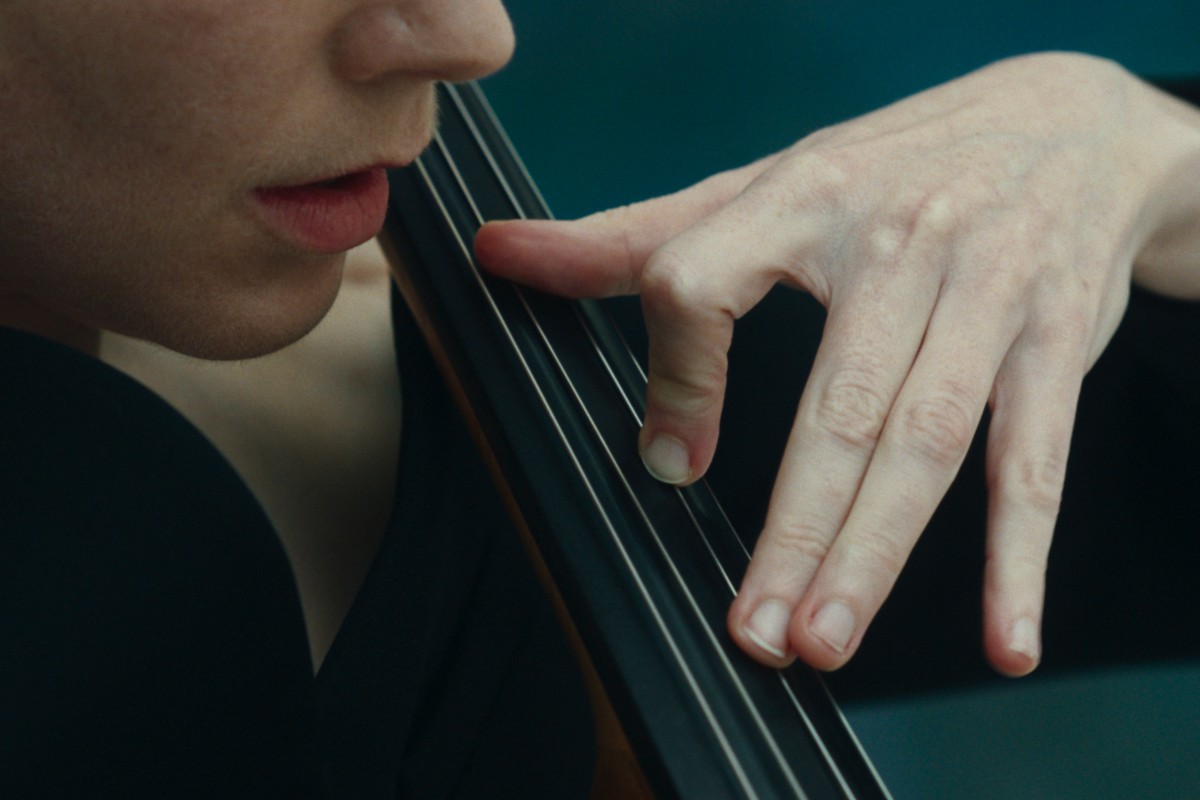
I am collaborating with Bastien Gallet on a trilogy of films. It tells the story of two metamorphoses. Two women are transformed. At first, these are only subtle signs. One is a cellist. She suffers from severe tinnitus, this new condition leads her to listen more deeply and changes the way she plays. The other is an art restorer. As she works on a strange metal floor, lines appear on her body, her behavior changes, she transforms. Something happens to them that they interpret as symptoms of an unknown illness. It is by accepting this and connecting with three sculptures that they are led to meet each other. A third character accompanies them: the Three Little Girls, whom they encounter several times. But the Three Little Girls also exist on another plane made of figures, lines and voices, where everything is replayed and transformed. The exhibition presented at the IAC is the prologue to this story. It consists of a film, a series of sculptures, and a sound installation. It is constructed like a vast musical score in which sounds, images, texts, sculptures, and gestures form motifs that recur, vary, and compose themselves over time.
Le loup dont la queue est poussée par le vent


This title is borrowed from an Inuit game which consists of making figures with a loop of string that is passed around the fingers. These figures are used to tell stories. Each figure represents something (animal, concept, part of the body, phenomenon, etc.). You move from one figure to another through intermediary forms and this is what determines the story. The two screens show three little girls. Their faces are fragmented as if they were a single entity. They tell a story, that of the creation of a game which is also the creation of a world. They contradict each other, cut each other off and we gradually see this world materialize: in the images that follow, through sound and through the sculptures. The breath of the three little girls becomes a wind that invades the whole space. They split into two, multiply, we see them walking separately in the forest and then, in the last shot of the film, they are reunited again. They play the game of strings. To keep on telling the story, several people are needed, but gestures replace words. They make a figure, the one that will be hammered on the floor of the next room, Daphné.
Daphné


A metal floor is hammered with lines that you discover as you walk across it. They invite us to follow them. At the back of the room, an intercom stands out in the light of a projector. A voice comes out and addresses us. You have to come closer to hear it, to share its space. She tells the story of the floor. It has not been added to the to the place, the place was designed around it, to welcome it, to clothe itself with it. This floor is a skin. It bears the scars of the place. The central design is handmade, the metal is struck with all the imperfections that this gesture entails, to create a relief. This drawing takes up the lines of the string figure seen in the film. Another technique is added to (opposed to) that of the hand. Certain lines are extracted and cut out by a digital machine. These two gestures are assembled to form a score that can be interpreted and give rise to performances. The first one will be walked, we will follow the thread, the second one will be played, we will interpret its signs.The voices of three little girls can be heard coming from a third space. They sing a nursery rhyme.
Soit je suis morte soit je deviens oiseau


Three mobiles are suspended from the ceiling, they rotate and with them the voices are set in motion by the three speakers perched there. The composition is random, sometimes we hear snatches of sentences, sometimes the of sentences, sometimes the whole rhyme which creates an echo with the film. “Three little girls do not listen, lose their skin, lose their voice. They change into what they are not. Paws, fur and disarray. Follow the line, skip the thread, walk the sign, run the furrow. If you follow the line your fingers will grow. If you skip the line your thoughts will fly [...]”. When the voices become scarcer, we hear birdsong from a quadraphonic system installed in the ceiling. If we listen carefully, these songs may seem strange and sometimes we will recognize the tune of the nursery rhyme. It is in fact with the whistles of Johnny Rasse, a bird singer, that we have composed this forest made of winds, voices hanging from branches that have become metal, and almost human birds. The three little girls have become voices. They seem to have invented a world, perhaps the one they were telling us in the film. We hear a breath crossing the space, the voice in the intercom in the distance sings the nursery rhyme, the breaths become wind, the sounds are coordinated, it is raining.

The title is borrowed from Anne Teresa De Keersmaeker, Embodying an abstraction.
Le loup dont la queue es poussée par le vent, multichannel film, 4K color, sound 7.1, 14’, 2022
Daphné, 90 hammered steel slabs, intercom, mono sound installation, 14’, 2022
Soit je suis morte soit je deviens oiseau, 3 steel sculptures, sound 7.1, 14’
With Adriana Kerzanet, Lee Fortuné-Petit, Esther Husson-Perlié, Aurélia Petit and Johnny Rasse. Texts: Bastien Gallet. DOP: Martin Roux. Editing: Constance Vargioni. Sound: Erwan Kerzanet and Nicolas Becker. In situ mixing: Johan Lescure. Metal floor fabrication: Wendy Andreu Mobile fabrication: Margot Pietri. The exhibition was produced by the IAC Villeurbanne, the Fondation des Artistes, the CNC – Centre national du cinéma et de l’image animée, and the GRAME – Centre national de création musicale de Lyon.
Pictures: Soit je suis morte soit je deviens oiseau, exhibition views, IAC Villeurvanne, 2022 ©Thomas Lannes